Strengthening Strategic Thinking Through Hashi Bridges Puzzles: A Modern Approach to Logic Training
In an era dominated by rapid digital distraction, the resurgence of structured logic games reveals something important about how professionals and creators are recalibrating their cognitive habits. The Easy, Medium Hard Hashi Bridges Puzzle collection represents more than a pastime — it reflects a growing demand for deliberate mental exercise that fits into flexible, self-directed routines. Whether you’re an entrepreneur sharpening decision-making skills, a marketer looking for a screen-free analytical reset, or a Print on Demand seller expanding your puzzle inventory, understanding the value of Hashiwokakero offers practical insight into why logic puzzles are thriving in both personal and commercial spaces.
What Is Hashiwokakero and How Does the Difficulty System Work?
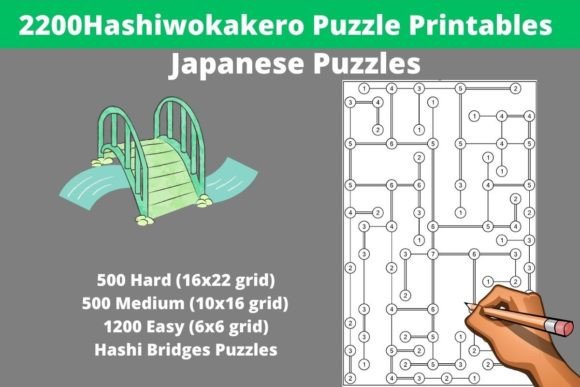
Hashiwokakero, often shortened to Hashi or called Bridges, is a logic puzzle originating from Japan. The name translates to "construct bridges," and the objective is deceptively simple: connect numbered islands with the correct number of bridges so that all islands form a single, interconnected network. Numbers on each island indicate exactly how many bridges must connect to it. Bridges run horizontally or vertically, never cross each other, and at most two bridges can link any pair of islands. The grid itself is rarely drawn — only the numbered circles, or "islands," appear, leaving players to deduce connections through pure reasoning.
The Easy, Medium Hard Hashi Bridges Puzzle collection organizes this experience across three distinct difficulty levels. The 6x6 grid puzzles labeled as Easy introduce the fundamental mechanics without overwhelming the solver. Medium puzzles expand to a 12x16 grid, requiring more layered deduction and pattern recognition. The Hard tier pushes into 16x22 territory, where sustained concentration and multi-step inference become essential. This graduated structure matters because it mirrors how adults learn complex skills: through progressive challenge that builds confidence before demanding mastery.
Why Logic Puzzles Are Gaining Attention in Professional Circles
The appeal of Hashi extends well beyond casual entertainment. Over the past several years, professionals across industries have shown increased interest in activities that support cognitive maintenance and mental agility. Neuroscientific research consistently points to the benefits of puzzles in maintaining neural plasticity, improving working memory, and enhancing problem-solving capabilities. But the shift isn’t merely about brain health — it’s about how work itself has changed.
Modern knowledge workers spend hours navigating ambiguous problems, untangling dependencies, and making decisions with incomplete information. Hashiwokakero exercises precisely these faculties. Each puzzle requires evaluating constraints, testing hypotheses, and recognizing when a single misplaced bridge creates cascading contradictions. The solver learns to hold multiple possibilities in mind while systematically eliminating impossibilities — a mental discipline directly transferable to strategic planning, project management, and data analysis.
The Analog Advantage in a Digital World
Another factor driving attention toward printable puzzles like this collection is the conscious move toward analog activities. Screen fatigue is real and well-documented. Professionals who spend eight or more hours staring at monitors increasingly seek leisure activities that engage the brain without adding to digital overload. A printed Hashi puzzle on paper offers tactile engagement — the scratch of a pencil, the physical act of drawing bridges, the satisfaction of erasing a wrong assumption. This sensory dimension enhances focus in ways that tapping on a screen often cannot replicate.
How the Printable PDF Format Aligns with Modern Consumer Expectations
Digital downloads have transformed how people access and use printed materials. The Easy, Medium Hard Hashi Bridges Puzzle product arrives as three PDF files containing a total of 2,200 Hashiwokakero puzzles, complete with instructions and solutions. There’s no physical shipment, no waiting for delivery, and no inventory to manage for the buyer. This model speaks directly to contemporary preferences around immediacy, flexibility, and sustainability.
Users download the files after purchase and print exactly what they need, when they need it. Each page holds one puzzle or one solution, giving complete control over layout. Someone who prefers compact travel sheets can print multiple puzzles per page using printer settings. Someone who wants spacious grids for clear notation can print one per sheet on letter or A4 paper. There’s no waste, no excess, and unlimited reprints for personal use across months or years.
Commercial Use and the Print on Demand Opportunity
For entrepreneurs and creators, the commercial license included with this puzzle collection opens a practical revenue avenue. Selling puzzle books through platforms like Amazon KDP has become a viable business model, and Hashiwokakero occupies a niche with dedicated demand. Puzzle enthusiasts regularly search for fresh content, and a collection spanning Easy, Medium, and Hard difficulty levels provides material for multiple product formats — single-difficulty books, mixed-difficulty samplers, or themed puzzle journals. The clarity of the included solutions also reduces post-purchase friction for end customers, a factor that directly affects reviews and return rates on print-on-demand marketplaces.
Connecting Hashi Puzzles to Broader Trends in Education and Cognitive Wellness
The educational sector has quietly embraced logic puzzles as supplementary learning tools. Teachers and homeschooling parents use Hashiwokakero to develop logical reasoning without the pressure of formal mathematics. The puzzles require no language fluency beyond number recognition, making them accessible to diverse learners, including those for whom English is not a first language. This universality contributes to the puzzle's global appeal and its suitability for multicultural classrooms and family settings.
Within the cognitive wellness space, activities like Hashi are increasingly recommended alongside meditation, physical exercise, and nutrition as part of holistic brain-care routines. Organizations focused on aging populations highlight puzzles as engaging tools for maintaining cognitive reserve. Younger adults, meanwhile, embrace them as productive alternatives to passive scrolling. The Easy, Medium Hard Hashi Bridges Puzzle collection fits neatly into these lifestyle patterns because the difficulty range accommodates everyone from complete beginners to seasoned solvers seeking genuine challenge.
Pattern Recognition and the Creative Professional
There’s a less obvious but equally important benefit for creative professionals. Hashiwokakero trains pattern recognition, a cognitive skill that underpins design thinking, content strategy, brand development, and innovation. Recognizing how constraints interact, where bottlenecks form, and how to build connections across seemingly isolated elements — these are not just puzzle mechanics. They mirror the creative process itself. A graphic designer working through layout constraints, a writer structuring narrative threads, or a marketer mapping customer journeys engages in reasoning with structural similarities to solving a Hashi puzzle. Regular practice with such puzzles sharpens an intuitive grasp of interdependence and sequential logic.
Practical Observations from Daily Puzzle Practice
People who incorporate Hashi into their daily routines often report subtle but meaningful shifts. The first few Easy puzzles feel trivial — simple counting and obvious bridge placements. But moving into Medium territory introduces moments of genuine uncertainty where guessing leads to errors. This is where the puzzle teaches its most valuable lesson: the discipline of resisting assumptions. A solver might see two islands with a "3" and immediately want to connect them with two bridges, but the global constraints of the puzzle might forbid it. Learning to check the whole board before committing to a local solution builds a habit of holistic analysis.
The Hard puzzles, with their 16x22 grids and dense island clusters, demand sustained attention over 20 to 40 minutes or more. In a culture of fragmented focus, this extended concentration is itself a form of training. Completing one of these larger grids creates a cognitive afterglow — a calm, focused state that carries into other tasks. Professionals who tackle a Hard puzzle during a lunch break often describe returning to work with renewed clarity, having exercised their brain in a structured yet open-ended way.
What Makes This Collection Distinctive
The volume and structure of this offering set it apart from typical puzzle books. With 1,200 Easy, 500 Medium, and 500 Hard puzzles, the collection provides months or even years of progressive engagement. The inclusion of full solutions for every puzzle eliminates frustration — no unsolved puzzle lingers without resolution. The instructional material ensures that even someone encountering Hashiwokakero for the first time can start confidently. And the printable format, paired with commercial rights, makes it an asset rather than a one-time consumable.
For the individual user, this means a customizable, reusable resource that adapts to mood and available time. A quick Easy puzzle before a meeting. A Medium puzzle during a commute. A Hard puzzle reserved for weekends or deep-focus sessions. The collection grows with the solver's ability rather than becoming obsolete once simpler puzzles are mastered.
Integrating Hashi into Workflows and Learning Environments
Organizations exploring cognitive wellness initiatives or team-building activities might find printable puzzles a low-cost, high-engagement option. Unlike digital tools that require accounts, updates, and device compatibility, a printed Hashi puzzle is universally accessible. Teams can work on identical puzzles and compare approaches, revealing different thinking styles and fostering discussion about problem-solving strategies. The non-competitive, meditative nature of the activity makes it suitable for diverse personalities — it’s not about speed but about clarity of reasoning.
For educators, the graduated difficulty means differentiated instruction is built in. Students who grasp concepts quickly move to Medium and Hard puzzles. Those needing more time stay within the Easy range, building foundational skills without feeling left behind. The puzzles also work well as quiet, independent activities that develop focus and persistence — qualities increasingly recognized as predictors of long-term academic success.
Looking Forward Without Speculating
The steady demand for logic puzzles like Hashiwokakero reflects deeper, enduring human needs: the desire for mental stimulation, the satisfaction of solving structured problems, and the appeal of activities that exist apart from digital ecosystems. Formats like printable PDFs respect user autonomy — no subscriptions, no data tracking, no planned obsolescence. A file downloaded today works the same way years from now, on any device capable of opening a PDF, and prints on any standard paper size worldwide.
As conversations around screen time, cognitive health, and intentional living continue to evolve, resources that offer genuine mental engagement in a flexible, ownership-based format are likely to remain relevant. The Easy, Medium Hard Hashi Bridges Puzzle collection embodies this positioning — practical, accessible, challenging without being alienating, and useful at both personal and commercial levels. Whether you’re solving for yourself or building products for others, the bridges you construct on these grids mirror the connections you strengthen in your own thinking.
For those ready to begin, the path is straightforward: download, print, and start with an Easy puzzle. The rules take minutes to learn. The strategic depth unfolds over hundreds of puzzles. And the cognitive rewards compound quietly, one bridge at a time.