Mastering Logic and Fun: Your Guide to 1000 Printable Binario Puzzles
In a world where digital distractions are constant, there is something deeply satisfying about sitting down with a pencil and a well-crafted logic puzzle. Among the most engaging and accessible brain teasers available today is Binario, also known as Binary Puzzle or Takuzu. If you have been searching for a substantial, organized, and beautifully designed collection to sharpen your mind or entertain your family, a comprehensive set of 1000 Binario Puzzles Printable PDF files might be exactly what you need. This downloadable treasure trove offers hours of screen-free stimulation across multiple difficulty levels, complete with solutions and clear instructions.
What Exactly Is a Binario Puzzle?
Before diving into the value of a massive 1000-puzzle collection, it helps to understand the game itself. Binario is a logic-based number placement puzzle played on a rectangular or square grid. Unlike Sudoku, which uses numbers 1 through 9, Binario strips things down to the most fundamental digital language: zeros and ones. The goal is to fill every cell in the grid with either a 0 or a 1, following a specific set of rules that create a uniquely satisfying challenge.
The puzzle typically appears in sizes like 6x6, 8x8, 10x10, and 12x12 grids. The larger the grid, the more complex the logical chains become. At first glance, a grid half-filled with 0s and 1s might look simple, but the deductive reasoning required can be surprisingly deep. Each puzzle has exactly one correct solution, and finding it requires careful attention to four fundamental rules.
The Four Simple Rules That Create Endless Challenge
What makes Binario so elegant is that the entire game rests on just four guidelines. They are easy to learn but interact in complex ways as the grid fills up. For anyone new to the game or looking at a fresh collection of puzzles, memorizing these rules is the first step to mastery:
- Each box must contain either a 0 or a 1. There are no other choices, no numbers above 1, and no blank spaces allowed in the completed puzzle.
- No more than two identical digits can be adjacent horizontally or vertically. This means you cannot have three zeros or three ones in a row, either across or down. A sequence like 0-0-1 or 1-0-0 is fine, but 0-0-0 is forbidden.
- Every row and every column must contain an equal number of zeros and ones. In a 10x10 grid, for example, each row and each column will contain exactly five zeros and five ones. This parity rule is a powerful tool for deduction when you are stuck.
- No two rows can be identical, and no two columns can be identical. Each row and column has its own unique identity. This rule often comes into play in the final stages of solving, helping you eliminate possibilities that would create duplicate lines.
These rules work together like a beautiful logical framework. The constraint that rows and columns must be unique, combined with the equal-count requirement, means you are not just filling cells randomly—you are constructing a perfectly balanced binary matrix. Like Sudoku, most Binario puzzles start with several squares already filled in. Your job is to use logic, not guessing, to complete the grid.
Why a 1000-Puzzle Collection Changes Everything
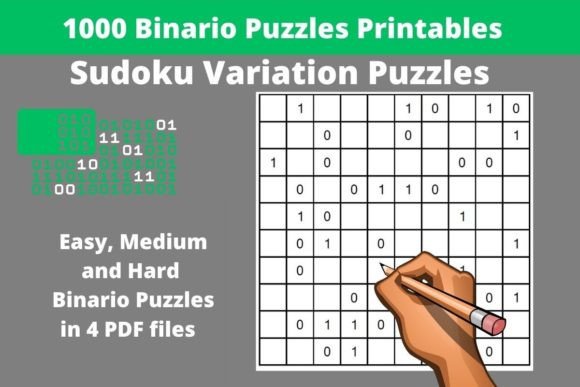
Finding individual Binario puzzles online is not difficult. But having a curated, well-organized set of 1000 puzzles with solutions transforms the experience from casual distraction into a proper hobby or daily mental workout. This particular collection is thoughtfully divided into four PDF files covering three distinct difficulty levels, ensuring that you never run out of appropriate challenges.
The structure is designed for progression. You start with approachable grids and work your way up to genuinely demanding puzzles that can take even experienced solvers a significant amount of time to crack. The breakdown is generous and logical:
- 400 Easy puzzles using 6x6 grids, with 4 puzzles per page for quick, satisfying solves.
- 400 Medium puzzles using 10x10 grids, also arranged 4 per page, offering a noticeable step up in complexity.
- 200 Hard puzzles using 12x12 grids, with 2 puzzles per page to give you plenty of room for notation and deep thinking.
This adds up to exactly 1,000 unique binary problems, each with its own single, verifiable solution included at the end of the files. The inclusion of solutions is crucial—it means you can check your work, learn from mistakes, and never remain stuck indefinitely.
Understanding the Grid Sizes and Difficulty Progression
The jump from 6x6 to 10x10 to 12x12 is not just about more cells. It represents a fundamental shift in the complexity of the logical chains you must follow. Understanding these differences helps you appreciate the value of having all three levels in one collection.
6x6 Grids: The Perfect Starting Point
The 6x6 easy puzzles are where beginners should start. With only 36 cells total and each row requiring three zeros and three ones, the deductive steps are relatively short. These puzzles often resolve quickly once you grasp the basic patterns—spotting where two identical digits force a different one, or identifying rows that are nearly complete. For children, seniors looking to keep their minds active, or anyone new to logic puzzles, the 6x6 format provides a welcoming entry point without being trivial. Having 400 of them means you can build genuine fluency before moving on.
10x10 Grids: The Sweet Spot of Engagement
The 10x10 medium puzzles represent the heart of the collection for many solvers. Each row and column must contain five zeros and five ones, which introduces richer combinatorial possibilities. The grids are large enough that you cannot simply intuit the answer—you must systematically apply the rules, tracking parity and checking for duplication. Yet they are still manageable enough to solve during a lunch break or a quiet evening. With 400 medium puzzles available, you have a deep well of engaging challenges that will keep your logical skills sharp for months.
12x12 Grids: The Ultimate Test
For those who crave a serious mental workout, the 200 hard puzzles on 12x12 grids deliver. With six zeros and six ones per row and column, and a much larger playing field, these puzzles require sustained concentration and multi-step deduction. You will often find yourself holding several possibilities in mind, testing hypotheses, and using the uniqueness rule to break through stalemates. The fact that these are printed two per page is a thoughtful touch—it gives you the visual space needed for pencil marks and careful analysis without feeling cramped.
The Practical Benefits of a Printable PDF Format
One of the most appealing aspects of this product is that it comes as a PDF digital download. There is no physical shipment, no waiting for delivery, and no clutter of physical books unless you choose to print them. Once you complete your purchase, you can download the files immediately and start solving within minutes. This instant access is perfect for several scenarios:
- Travel preparations: Print a stack of puzzles before a long flight, train ride, or road trip.
- Classroom use: Teachers can print copies for students as logic exercises, early-finisher activities, or brain breaks.
- Family gatherings: Print multiple copies of the same puzzle and have friendly competitions to see who solves it fastest.
- Senior centers and care facilities: Engaging with logic puzzles supports cognitive health, and having unlimited printable copies is cost-effective for group settings.
- Personal archives: You can solve puzzles you enjoy, keep them, and re-print favorites whenever you like.
The PDF format also means you control the paper quality. Use standard printer paper for everyday solving, or print on heavier stock if you prefer a more premium feel. You can even laminate a few puzzles and use dry-erase markers for reusable fun. The flexibility is entirely in your hands.
How Binario Puzzles Fit Into Modern Life and Cognitive Wellness
It is worth stepping back to consider why activities like solving Binario puzzles matter in today's world. We spend enormous amounts of time consuming passive content—scrolling through social media, watching videos, reading headlines. Active, focused problem-solving engages the brain in a fundamentally different way. Logic puzzles require sustained attention, pattern recognition, working memory, and deductive reasoning.
Research into cognitive aging suggests that mentally stimulating activities—including puzzles—can contribute to maintaining cognitive function as we grow older. While no single activity is a magic bullet, a lifestyle that includes regular problem-solving is widely considered beneficial. Binario puzzles are particularly well-suited because they are low-stress yet genuinely demanding. Unlike timed competitive games or high-stakes trivia, you can work through a 10x10 grid at your own pace, experiencing the quiet satisfaction of logical discovery.
For younger individuals, these puzzles build valuable skills that transfer to mathematics, computer science, and engineering. The binary nature of the game introduces fundamental concepts of boolean logic in an intuitive, playful way. Understanding constraints, working within rules, and systematically eliminating possibilities are all core practices in programming and algorithm design.
Common Misunderstandings About Binary Puzzles
When people first encounter Binario, a few misconceptions tend to surface. Clearing these up can dramatically improve the solving experience.
"It's just guessing." This is perhaps the most common assumption. In reality, a well-designed Binario puzzle never requires guessing. Every cell can be logically deduced from the given information and the four rules. If you find yourself guessing, it usually means there is a deduction you have not yet spotted. The solutions included in the PDF collection help you identify those blind spots.
"The uniqueness rule doesn't matter until the end." Beginners often ignore the rule that rows and columns must be unique, thinking it only applies as a final check. In practice, this rule can be a powerful tool throughout the solving process. If filling a particular cell would force a row to become identical to another already-completed row, you know that choice is incorrect.
"Bigger grids are just more of the same." While the rules do not change, the solving experience on a 12x12 grid is qualitatively different from a 6x6. The larger the grid, the more you must hold in your head simultaneously, and the more layers of indirection exist in the logical chain. The 200 hard puzzles in this collection are genuinely challenging, even for experienced solvers.
Getting the Most Value From Your 1000 Puzzles
To truly enjoy and benefit from a collection of this size, a bit of intentionality goes a long way. Here are some practical suggestions for integrating these puzzles into your routine:
- Start with the instruction page. The PDF includes clear guidelines on how to play. Even if you are familiar with the rules, reviewing them ensures you are approaching the puzzles correctly.
- Progress naturally through the levels. Do not jump straight to 12x12 unless you are confident. Building skills on the 6x6 grids will make the harder puzzles more enjoyable rather than frustrating.
- Keep a pencil with an eraser handy. These are logic puzzles, not pen-and-ink tests. You will want to make light marks, track possibilities, and occasionally correct a mistaken path.
- Use the solutions as a learning tool, not just an answer key. If you get stuck, try to understand the logical step you missed rather than simply checking whether your answer matches.
- Create a daily ritual. One 10x10 puzzle with your morning coffee or a 6x6 puzzle before bed can become a calming, centering habit.
Why This Collection Stands Out
There are free Binario generators on the internet, and puzzle apps on every app store. What makes a carefully compiled 1000-puzzle PDF collection different is the combination of curation, consistency, and permanence. Each puzzle is designed to have exactly one solution, and the collection has been organized with attention to difficulty progression and page layout. You are not solving randomly generated grids of varying quality—you are working through a thoughtfully constructed set where every puzzle has been verified.
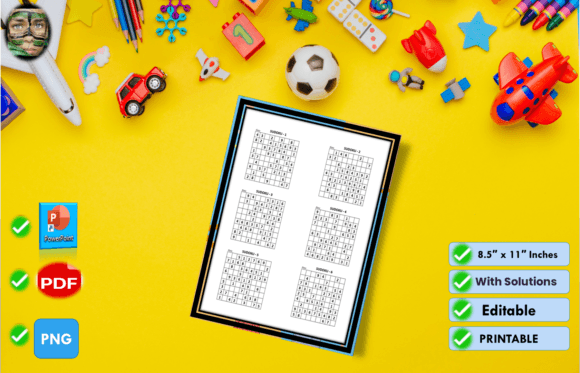
The page layouts are practical, too. Placing four smaller puzzles on a page for the easy and medium levels makes efficient use of paper without making the grids too small to read. For the harder 12x12 puzzles, giving each pair more space acknowledges the extra notation and concentration required. These details reflect a product created by someone who understands how people actually solve puzzles.
For parents, educators, puzzle enthusiasts, or anyone looking to reduce screen time while keeping their mind engaged, a downloadable PDF collection of 1000 Binario Puzzles with solutions offers extraordinary value. It is a one-time purchase that can provide months or even years of entertainment, all from your own printer. Whether you are discovering the joy of binary logic for the first time or you are a seasoned solver seeking a fresh mountain of challenges, the combination of 400 easy, 400 medium, and 200 hard puzzles ensures there is always something right for your current mood and energy level.