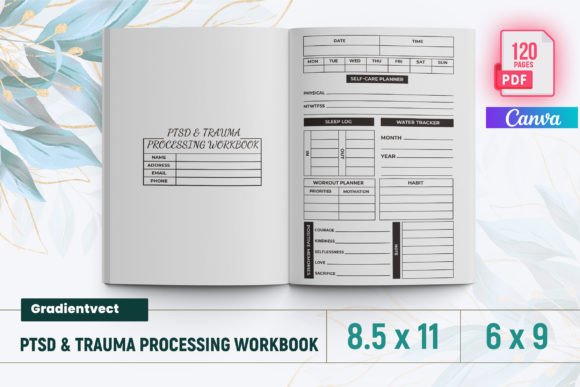
Making Sense of the KDP PTSD Trauma Processing Workbook: A Practical Approach to Healing and Publishing
When you first encounter a resource like the KDP PTSD Trauma Processing Workbook, it’s easy to see it as just another downloadable template. But if you pause and look closer, you’ll find something far more useful: a structured, thoughtfully designed interior that bridges the gap between clinical insight and accessible self-work. Whether you're a publisher building a catalog of mental health resources or an individual seeking a guided path through trauma recovery, how you use this workbook determines the value you extract from it.
What the Workbook Actually Delivers — And What That Means for You
The package is comprehensive without being overwhelming. You receive a ready-to-upload PDF file sized at both 6x9 and 8.5x11 inches, spanning 120 total pages with an intro page and bleed settings already configured. These files have been tested on Amazon KDP, which matters more than many realize. KDP's printing specifications can be unforgiving — margins shift, text cuts off, customer returns spike. Having a pre-tested interior eliminates hours of troubleshooting and costly re-uploads. For independent publishers and creators, this alone transforms the workbook from a "nice idea" into a reliable asset you can confidently list within days, not weeks.
Beyond the technical specs, you also receive PNG and JPG files, along with editable source files. This opens up genuine customization opportunities. You can adjust fonts, tweak the therapeutic language to match your audience's reading level, or rebrand the interior under your own imprint — all without starting from a blank page. The editable files mean the workbook isn't locked into one vision. If you serve a niche demographic — veterans, first responders, survivors of specific trauma types — you can tailor the interior to speak directly to their lived experience.
The Interior Layout: More Than a Collection of Prompts
Flip through the 120 pages, and a clear therapeutic architecture emerges. The workbook doesn't just throw journaling prompts at the reader. It sequences the experience intentionally, beginning with orientation and moving through progressively deeper layers of self-work.
Laying the Groundwork: Belongs To Page and Introductory Framing
The inclusion of a Belongs To page seems minor, but in trauma work, personalization matters. Claiming ownership of the workbook is a small act of agency — one that sets the tone for the pages ahead. The intro page frames expectations without overwhelming someone who might already be in a heightened state of vigilance. For publishers, these opening pages are where you can introduce your brand voice subtly, perhaps through the design or a short note, without disrupting the therapeutic flow.
Pattern Recognition and Emotional Awareness
Sections dedicated to working on patterns and learning to respond, not react form the cognitive backbone of the interior. These aren't abstract concepts. The prompts guide the user toward identifying recurring emotional sequences — the kind that often operate beneath conscious awareness. "I'm aware that my thoughts are not me" isn't just a platitude here; it's scaffolded with exercises that help separate identity from intrusive cognitions. This distinction is foundational in trauma processing, and the workbook handles it with the right amount of repetition without becoming tedious.
Acknowledging Thoughts and Feelings Without Merging With Them
The pages on acknowledging thoughts and feelings, paired with facilitating healing, invite dual awareness. Users learn to observe their internal experience without being consumed by it. For someone new to this concept, the workbook provides enough structure to feel safe while leaving room for honest reflection. The self-blame and self-acceptance sections sit close together — a deliberate pairing. You can't rush someone from shame to self-compassion; you have to give them space to name the blame before releasing it. The workbook respects that pacing.
Practical Tools Embedded in the Pages
One feature that sets the KDP PTSD Trauma Processing Workbook apart from simpler journals is the inclusion of tangible coping aids. These aren't afterthoughts. They're integrated into the flow with clear instructional framing.
Trigger Coping Cards and Processing Nightmares
The trigger coping cards serve as portable interventions. Someone can fill them out during a calm moment, then access them when triggers arise in daily life. This bridges the gap between workbook sessions and real-world application. Similarly, the processing nightmares section doesn't ask users to relive distressing dreams in exhaustive detail. Instead, it provides a contained, structured format that helps extract meaning without re-traumatization. For a reader dealing with sleep disturbances, these pages offer a grounded starting point before — or alongside — professional support.
Worry Coping Cards and Physical Coping Skills for Anger Management
Two complementary sections address the somatic side of trauma responses. Worry coping cards help intercept anxious spirals before they escalate, while physical coping skills for anger management ground the user in body-based regulation strategies. This isn't just "take a deep breath" advice. The prompts likely guide users toward identifying what physical interventions feel accessible and effective for them personally — a far more sustainable approach than one-size-fits-all suggestions.
Breathing Exercises and Mental Visualization
The heart breathing exercise and the balloon mental exercise introduce simple but evidence-informed techniques. Heart breathing — slow, rhythmic breathing with a focus on the heart center — has roots in biofeedback and vagal tone research. The balloon exercise, a visualization technique often used with children but equally effective for adults, externalizes anxious thoughts in a non-threatening way. These pages work well as daily resets, not just crisis interventions.
Moving From Processing to Building
A subtle but important shift happens midway through the workbook. The focus expands from symptom management to life-building. The Building My Dream Life and My Vision Board sections signal that healing isn't just about reducing distress — it's also about reclaiming direction. The monthly reflections and monthly goal planning pages create natural check-in rhythms. Trauma can fracture one's sense of future; these planning tools help rebuild it incrementally.
Weekly Self-Care and Daily Reflection
The weekly self-care spread and daily reflection pages provide the tactical layer. Self-care often gets reduced to bubble baths and candles in popular culture, but this workbook frames it as an ongoing practice of attunement. The daily reflection likely prompts not just "how did you feel?" but "what did you notice about your patterns today?" — a subtle but important distinction. The weekly task planning and good habits trackers round out the practical toolkit, grounding emotional work in observable, trackable behaviors.
Self-Worth, Self-Compassion, and Discovering Authentic Self
Sections on self-worth, self-compassion, and discovering my authentic self sit near the workbook's latter portion — appropriately so. You can't rush someone into self-compassion before they've processed blame and shame. The positioning suggests the workbook was structured by someone who understands the arc of trauma recovery. The decatastrophizing exercises, overcoming fear prompts, and self-love work build on the earlier cognitive and somatic tools, integrating them into a more cohesive sense of identity.
Strategic Use Cases: Publishing and Personal Application
Let's talk about decision-making. If you're a publisher or creator considering this workbook for your KDP catalog, your strategic advantage lies in the editable files. You can refine the language to serve specific populations, incorporate your branding, and differentiate your listing in a crowded niche. But the real opportunity is in your marketing positioning. Don't just list it as a "trauma workbook." Position it around a specific use case — perhaps "a 30-day guided trauma processing plan" or "a therapist-designed companion for between-session work." The existing interior supports these angles; you just need to frame your listing copy accordingly.
For Individual Users: Working With the Workbook Intentionally
If you're using this workbook personally, resist the urge to speed through it. Trauma processing isn't a checklist. Pick one section — perhaps trigger processing or self-acceptance — and sit with it for several days before moving on. Use the daily reflection pages as anchor points, and let the coping cards live somewhere accessible, not just inside the book. The workbook works best when you treat it as a practice space, not a test you're trying to pass.
Integrating the Workbook With Professional Support
A realistic note: no workbook replaces professional trauma therapy. But a well-structured one can enhance it. Consider bringing completed pages to therapy sessions as conversation starters. The coping with grief and loss section, for example, might surface material worth exploring with a counselor. The anger management tools can complement therapeutic work rather than existing in a vacuum. Use the workbook as a bridge between sessions, not a substitute for clinical care.
Avoiding Common Pitfalls
One risk with any structured resource is approaching it rigidly. If a particular prompt doesn't resonate, skip it. If the decatastrophizing exercise feels too conceptual on a given day, move to something somatic like the breathing exercises. The workbook contains multiple entry points for a reason — trauma processing isn't linear, and your engagement with the material shouldn't be either.
For publishers, avoid the temptation to over-customize to the point of losing clinical coherence. If you heavily edit the interior, maintain the therapeutic arc. The sequence from acknowledging thoughts and feelings through to self-compassion and vision boarding follows a logical progression. Disrupt it carelessly, and the final product may confuse readers rather than guide them.
Long-Term Value: Beyond the First Use
A 120-page workbook with monthly reflection and goal-planning components isn't a single-use product. Someone can work through it over several months, revisit sections as new layers of processing emerge, or use the blank planning tools repeatedly. For publishers, this creates natural upsell opportunities — a companion journal, a digital supplement, or a follow-up workbook focused on a specific sub-topic like anger or grief. The interior's structure hints at multiple product extensions without forcing your hand.
Ultimately, the KDP PTSD Trauma Processing Workbook provides what most resources in this space miss: a balance of structure and flexibility, ready-to-publish reliability, and enough depth to hold real therapeutic weight without becoming inaccessible. Whether you're building a publishing catalog, supporting a client base, or navigating your own healing, the value lies not just in the pages themselves, but in how intentionally you choose to work with them.