Competitor Tracking: Beyond Spreadsheets
Imagine you have spotted a rival launching a new product or adjusting their pricing. You scribble a note on a sticky pad or add a row to a spreadsheet. Weeks later, you can't find the context, or the data is buried in a cluttered file. This is the silent drain on strategic momentum that many professionals face. The Competitor Tracker Log Book is designed to end that fragmentation by providing a structured, yet adaptable, central system for your competitive intelligence.
What This Log Book Actually Does
At its core, the Competitor Tracker Log Book is a dedicated framework for observation, recording, and analysis. It replaces ad-hoc notes and disparate documents with a consistent format. Think of it not as a single-use checklist, but as a living document for your market landscape. Its primary utility is in transforming casual observation into actionable insight.
Why is this useful? Because competitive analysis is rarely a one-time event. It's a continuous process. Without a system, insights are lost, trends are missed, and responses are reactive instead of proactive. This log book provides that system, enabling you to track changes over time, correlate different data points, and build a comprehensive picture of your competitive environment.
Key Characteristics and Strengths
The notable quality of this particular resource is its focus on practical application. It isn't a theoretical guide; it's a tool ready for immediate use. The inclusion of AI files, PDFs, SVG files, and high-resolution CMYK color assets at 300 DPI speaks to its versatility. This means the log book can be seamlessly integrated into digital workflows, printed for physical team meetings, or adapted into branded presentations without loss of quality.
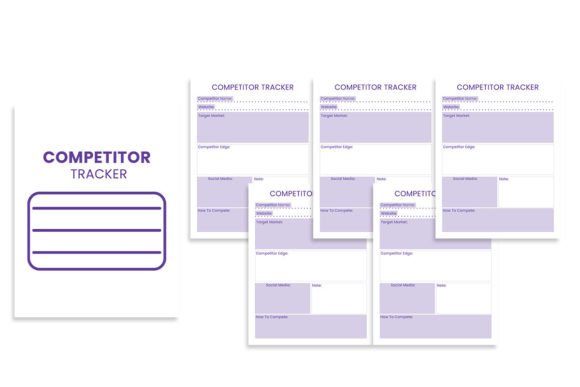
- Structure with Flexibility: It provides essential categories—like competitor name, observed action, date, potential impact, and your response—but doesn’t lock you into a rigid form. You can adapt sections to track social media campaigns, supply chain shifts, or customer sentiment.
- Visual and Data-Ready: The high-quality files ensure that any charts, logos, or visual summaries you create maintain professional polish. The SVG files allow for easy scaling and modification in design software, which is crucial for in-house marketing teams.
- Multi-Format Utility: Having both editable AI files and stable PDFs means you can start with a digital version, tailor it, and then distribute print-ready sheets to a team that prefers physical notebooks.
Real-World Applications Across Fields
The use of a Competitor Tracker Log Book extends far beyond corporate strategy rooms. Its principles are applicable wherever there is a need to monitor peers, benchmark performance, or identify opportunities.
For Entrepreneurs and Small Business Owners
A local cafe owner might use it to track the menu changes, promotional events, and customer feedback tactics of other cafes in the district. By logging these observations systematically, they can identify gaps—perhaps a competitor lacks a strong loyalty program—and launch a targeted initiative to fill it. The physical print-out could be kept by the register for quick daily notes.
For Content Creators and Bloggers
In the digital content space, tracking isn't about products but about topics, engagement tactics, and platform algorithms. A blogger could use the log to record when a competing channel launches a successful video series, the keywords they're ranking for, or their community interaction style. Over time, this log becomes a content strategy map, highlighting trends in audience preference without resorting to guesswork.
For Educators and Trainers
Even in academia or professional training, understanding what other institutions or course providers are offering is key. An educator developing a new course module could track the syllabus structures, delivery methods, and pricing of similar courses. This ensures their offering is both competitive and distinctive, adding unique value where others are lacking.
For Marketing Teams and Freelancers
This is perhaps the most direct application. Marketing teams can assign different competitors to team members, using a standardized log book page to ensure all reports follow the same format. This streamlines weekly review meetings. A freelance marketer managing multiple clients can use separate log instances for each client’s competitive landscape, providing clear, structured reports as part of their service.
The Tangible Benefits of Systematic Tracking
Moving from scattered notes to a unified Competitor Tracker Log Book delivers several concrete benefits that impact daily workflow and long-term outcomes.
Enhanced Efficiency and Productivity: The time spent searching for old emails or deciphering handwritten notes is eliminated. All intelligence is in one place, categorized and time-stamped. This makes preparing for strategic reviews or board updates significantly faster.
Improved Communication and Alignment: When everyone on a team uses the same log format, communication improves. Discussions are based on a common set of structured data, reducing ambiguity. The PDF and print-ready nature supports this by allowing easy sharing of standardized updates.
Proactive Rather Than Reactive Posture: By reviewing a log that shows a competitor’s gradual price reduction over three months, you can plan a response. Without the log, you might only notice the final price change and be forced into a sudden, rushed decision.
Branding and Presentation Quality: The high-resolution CMYK files mean any visual summaries you create—for instance, a trend graph inserted into a client presentation—will look professional and credible. This strengthens your own brand's perception as meticulous and data-driven.
Practical Considerations for Implementation
Adopting any new system requires a bit of forethought. Here are some realistic observations on making the Competitor Tracker Log Book work for you.
First, select the right format for your primary workflow. If your team is entirely digital and uses design software, start with the AI files. If you need quick distribution and simplicity, the PDFs are ideal. You might even use both: AI files for the master template maintained by a manager, and PDF print-outs for field staff.
Second, don't over-complicate the entries initially. The goal is consistency and longevity. Start with the basic fields. As you get comfortable, you can expand sections using the editable files to add custom columns like "Estimated Budget" or "Customer Reaction."
Third, integrate the log into a regular review cycle. Its value multiplies when reviewed periodically. Schedule a brief monthly session to look over the accumulated entries and identify patterns. This turns raw data into strategy.
Finally, consider the scope of tracking. It's easy to fall into the trap of tracking too many competitors or too many metrics. Define a clear focus—perhaps three main rivals and two key areas (like pricing and marketing). This keeps the log manageable and the insights sharp.
Beyond Business: A Tool for Personal Development
An interesting use case emerges even for individuals. A freelance graphic designer, for instance, could track other freelancers' portfolio updates, rate changes, and client engagement styles. This isn't about imitation; it's about understanding the market's evolution and positioning one's own services accordingly. The log becomes a personal business development tool.
The Competitor Tracker Log Book, with its suite of ready-to-use high-quality files, ultimately serves as a bridge between observation and action. It provides the structure that turns sporadic information into a coherent narrative about your competitive landscape. Whether you're a marketer in a global firm, a blogger in a niche field, or an entrepreneur building a local brand, the discipline of systematic tracking can clarify your path and sharpen your response. The key is to start simply, use the formats that match your environment, and let the log build the story over time.