How an Audiobook Logbook - KDP Interior Compares to Other Tracking Methods for Serious Listeners
Keeping track of audiobooks might seem straightforward until the collection grows past a dozen titles. Narrators blend together, favorite moments fade, and the question "Have I already listened to this?" becomes uncomfortably familiar. An Audiobook Logbook - KDP Interior addresses this directly by offering a structured, physical space designed for cataloging every title with consistency and care. Unlike scattered digital notes or memory alone, this template provides a repeatable framework that turns casual listening into an organized, searchable archive.
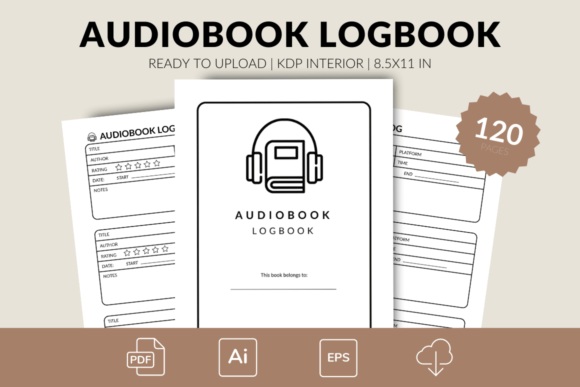
What sets this particular logbook apart from other record-keeping options is its origin as a KDP-ready interior file. The design has already been tested and optimized for Amazon's print-on-demand platform, which removes a significant barrier for anyone looking to publish their own logbook rather than buy someone else's. The 8.5x11-inch format with 120 pages and no-bleed layout reflects practical decisions made to balance usability with production requirements. For the person evaluating whether this template fits their publishing or personal use goals, understanding how it lines up against alternatives — both digital and physical — makes the decision clearer.
What the Audiobook Logbook - KDP Interior Actually Provides
At its core, this is a pre-designed interior file package intended for self-publishers who want to create and sell an audiobook tracking journal on Amazon KDP. The purchase includes a high-quality PDF ready for direct upload, along with editable source files in AI and EPS formats. A cover template comes bundled in PNG, AI, and EPS versions. There is also a copyright text section built into the design, which handles attribution without requiring the publisher to draft legal language from scratch.
The 120-page count hits a practical sweet spot. At one entry per page, that accommodates 120 audiobooks — a substantial collection by most standards. The no-bleed specification means the interior design stays within standard print margins, reducing the risk of formatting rejections during the KDP review process. These technical details matter less to the end user who simply wants a well-designed tracking journal, but for the publisher uploading files, they translate to fewer headaches and faster approval times.
Physical Logbooks Versus Digital Tracking Apps
Many listeners default to apps like Goodreads, StoryGraph, or simple spreadsheet files for audiobook tracking. These tools offer convenience — entries sync across devices, searching is instant, and sharing recommendations with friends takes seconds. They also cost nothing or very little compared to purchasing a printed journal.
However, digital tools carry tradeoffs that become more apparent over years of use. Platforms change their interfaces, companies shutter services, and data exports are not always clean or complete. A listener who has logged hundreds of audiobooks in an app may find that a decade of careful notes becomes inaccessible if the service discontinues or alters its export functionality. There is also the question of attention: logging a book on a phone often happens alongside notifications, messages, and the gravitational pull of other apps. The act of writing by hand in a physical logbook — like one created from an Audiobook Logbook - KDP Interior template — tends to be slower, more deliberate, and less prone to the distraction-hopping that characterizes screen-based tasks.
Physical logs also serve a different sensory purpose. A shelf of completed logbooks becomes a tangible record of listening history, something that digital lists do not replicate. For listeners who value the ritual of sitting down with a pen after finishing a particularly meaningful audiobook, the physical format holds appeal that apps cannot match.
Comparing This KDP Template to Generic Notebooks
A blank notebook offers complete freedom. There are no predetermined fields, no structure to follow, and no constraints on how much or how little to write about each audiobook. For a small subset of users, that flexibility is exactly what they want. They might sketch mind maps, paste ticket stubs from author events, or write sprawling reflections that span multiple pages per title.
The limitation of the blank notebook approach reveals itself over time. Without consistent fields, it becomes difficult to quickly scan past entries for specific information. Was the narrator for that historical fiction title Simon Vance or John Lee? Did I rate that mystery series four stars or five? When every entry follows a different format, answering these questions means rereading pages of freeform notes. The Audiobook Logbook - KDP Interior solves this by providing uniform entry fields — typically including space for the title, author, narrator, genre, start and finish dates, rating, and notes — so that every page follows the same organizational logic. Scanning becomes fast, and missing information stands out immediately rather than hiding in unstructured text.
There is also the aesthetic dimension. A well-designed template creates visual consistency that most people cannot easily replicate in a blank notebook without significant effort. The included source files mean publishers can adjust colors, fonts, or field arrangements to match a specific brand or audience preference, then produce a polished result without starting from a blank artboard.
How This Template Stacks Up Against Other KDP Interiors
The marketplace for KDP interior templates has grown substantially, with options available across a wide price and quality spectrum. Some templates offer higher page counts — 150 or 200 pages — which might appeal to publishers targeting listeners with very large collections. Others include more elaborate interior graphics, decorative borders, or themed artwork that caters to niche aesthetics like vintage library styles or minimalist modern designs.
Where the Audiobook Logbook - KDP Interior positions itself is in the practical middle ground. The 120 pages cover a realistic collection size without making the printed book unnecessarily thick or expensive to produce. The no-bleed design simplifies formatting and keeps per-unit printing costs predictable. The inclusion of multiple source file formats — AI, EPS, and PNG for the cover — means the publisher is not locked into a single editing application. Someone comfortable with Adobe Illustrator can work directly with the AI files, while someone using Affinity Designer or Inkscape can import the EPS versions without conversion headaches.
A factor worth weighing is the level of design complexity. Templates with heavy illustration work or intricate layouts can look impressive in preview images but sometimes create printing issues or feel visually busy in the reader's hands. Simpler, cleaner templates tend to be more forgiving during the KDP review process and often result in a more usable end product. This particular logbook template leans toward clean functionality over decorative flair, which suits readers who prioritize usability and clarity.
When an Audiobook Logbook - KDP Interior Makes the Strongest Fit
This template aligns well with several specific scenarios. First, for someone entering the low-content publishing space who wants to test the audiobook niche without commissioning custom design work, the ready-to-upload PDF and editable source files offer a low-risk starting point. The cover template eliminates the need to hire a separate designer or learn cover creation from scratch.
Second, for a personal user who wants a professionally structured journal but prefers to print and bind their own rather than buy a mass-market version, the PDF can be used directly. This route allows choosing paper weight, binding style, and cover material that suit individual preferences — options that off-the-shelf journals do not provide.
Third, the template works for small publishers or authors who already have an audience in the audiobook space and want to offer a branded companion product. Because the source files are editable, they can incorporate specific branding elements, adjust field labels to match their community's vocabulary, and create something that feels custom without the timeline or cost of original design work.
Situations Where Alternatives May Serve Better
The fixed 8.5x11-inch size and 120-page count may not fit every publishing strategy. A publisher aiming for a compact, travel-friendly format — something closer to 6x9 inches — would need to significantly rework the layout or look for a template already sized for that purpose. Similarly, someone targeting listeners who consume 200 or more audiobooks per year might find 120 entries limiting and prefer a template with a higher page count or a layout that fits multiple entries per page.
For users who want a purely digital solution, this physical logbook approach will feel unnecessarily constrained. There is no search function, no automatic calculation of listening statistics, and no ability to hyperlink between related entries. The tradeoff of tangibility for functionality is real, and listeners who value data analysis — average listening time per month, most-read genres by season, narrator frequency charts — will find spreadsheet tools or dedicated tracking apps more aligned with those goals.
Also worth considering: the template includes copyright text, which is helpful for published versions sold on Amazon, but a personal user printing a single copy for themselves may find the copyright page unnecessary. Removing it requires editing the source file, which assumes comfort with vector editing software. Someone without access to Illustrator or a comparable program might find this step frustrating despite the EPS format's broader compatibility.
Practical Decision Factors Worth Weighing
When evaluating whether this template fits a specific need, several practical factors deserve attention beyond the feature list. Print cost per unit scales with page count and color usage. At 120 pages with a no-bleed interior — which typically means black and white or grayscale content — the per-book manufacturing cost through KDP stays competitive. This leaves room for a retail price that balances profitability with customer expectations for a printed journal.
The learning curve for customization is another practical consideration. The AI and EPS formats assume familiarity with vector editing workflows. Someone new to these tools will face an initial time investment to make even simple changes like adjusting font sizes or rearranging field order. For those with design experience, however, this same flexibility is a significant advantage over templates that arrive only as flattened PDFs.
Finally, there is the question of audience match. The end user of a published logbook created from this template is likely someone who already values analog systems — bullet journal enthusiasts, commonplace book keepers, or readers who simply enjoy the tactile experience of pen on paper. Marketing a physical audiobook log to a purely digital-native audience would be an uphill effort. Understanding that the template serves a specific type of listener helps set realistic expectations for how the finished product will perform.
Making a Confident Choice Among the Options
The Audiobook Logbook - KDP Interior occupies a clear and useful position among the range of audiobook tracking approaches. It is more structured than a blank notebook, more permanent and focused than a phone app, and more accessible for new publishers than commissioning custom interior design. The included cover template and multiple source file formats add practical value that reduces the number of separate purchases or services needed to bring a finished logbook to market.
At the same time, the template is not a universal solution. Listeners who prioritize data analysis, those who want pocket-sized portability, and publishers targeting very high-volume listeners may find that other formats or higher-page-count templates align more closely with their goals. The decision hinges on a clear-eyed assessment of who will use the finished logbook and what they will value most — consistency and durability over flexibility, deliberate reflection over quick logging, and a physical archive over a cloud-based list.
For the right user or publisher, the match is strong. The design has been tested against Amazon's requirements, the page dimensions work well for handwriting, and the editable source files provide enough control to personalize without overwhelming complexity. Taking stock of the specific listening habits, publishing goals, and user preferences at play makes it possible to choose with confidence rather than guesswork.