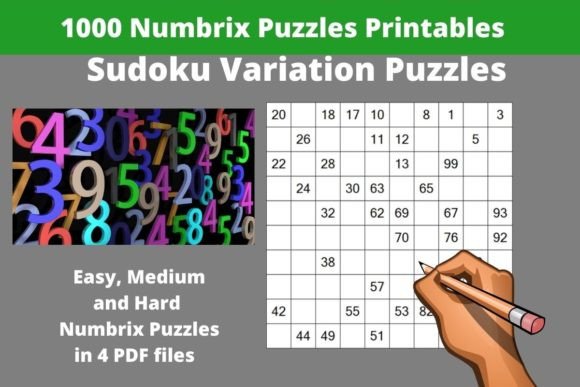
Easy, Medium and Hard Numbrix Puzzles
Numbrix, also called Numbricks, is a satisfying logic puzzle that asks you to rebuild a sequential number path across a grid. You move from one cell to the next in strict numerical order, connecting every digit without ever stepping diagonally. It sounds simple when you describe it that way, but the real charm sits in how the puzzle forces you to look ahead, backtrack mentally, and hold multiple possible routes in your head at once. This particular digital collection of Easy, Medium and Hard Numbrix Puzzles bundles 1,000 puzzles across four printable PDF files, so you always have fresh grids waiting whether you want a gentle warm-up or a genuinely stubborn challenge.
What makes this offering stand out is the structure. You do not get a vague pile of puzzles. You get three distinct difficulty tiers combined with a clear how-to-play guide, and every single puzzle arrives with its solution. The package breaks down like this: File 1 holds 400 easy 10×10 Numbrix puzzles plus their answers. File 2 gives you another 400 medium 10×10 puzzles and solutions. File 3 contains 200 hard 10×10 puzzles with solutions. File 4 is the instruction guide. That deliberate progression from easy through hard means you can start wherever your confidence level sits and steadily sharpen your reasoning skills without jumping into something that feels overwhelming right away.
What Numbrix Actually Asks of You
If you have never encountered Numbrix before, the concept is refreshingly uncomplicated. A partially filled grid sits in front of you. Some cells already display numbers. Your job is to fill every empty square so that the numbers run consecutively from the lowest to the highest, moving only horizontally or vertically. No diagonal shortcuts. No skipping cells. The path must wind through every single square exactly once, and the numbers must increase by precisely one with each step. This restriction creates a surprisingly deep puzzle experience because a single misplaced assumption early on can ripple through the entire grid and force a dead end twenty moves later.
Because diagonal movement is forbidden, the puzzle naturally teaches you to think in terms of adjacent possibilities. You learn to spot forced moves quickly. If a cell has only one neighbor available that fits the sequence, that neighbor becomes a certainty. Those certainties chain together, gradually unlocking the whole path. The Easy, Medium and Hard Numbrix Puzzles in this collection use a 10×10 grid throughout, which strikes a nice balance between manageable size and enough complexity to keep your attention. Smaller grids can feel trivial after a few solves. Larger ones can become tedious. A hundred cells per puzzle is a sweet spot.
How the Three Difficulty Levels Actually Differ
Difficulty in Numbrix does not come from changing the rules. The fundamental mechanics stay the same whether you are solving an easy puzzle or wrestling with a hard one. The difference sits in how many starting numbers appear on the grid and where those numbers are placed relative to one another. Easy puzzles tend to give you more anchored points. You might find that several consecutive numbers are already visible, creating obvious bridges that reduce the number of branching possibilities. Medium puzzles thin out those clues. You encounter longer gaps between given digits, which forces you to hold more alternatives in your head before you can commit to a path. Hard puzzles push this further still, sometimes giving you just enough numbers to establish the boundaries of the sequence while leaving vast stretches of the grid open to interpretation.
What this means in practice is that the easy tier feels welcoming and meditative. You can solve a handful of puzzles during a coffee break and walk away with a sense of completion. The medium tier demands more sustained concentration but rarely feels punishing. The hard tier genuinely tests your logical endurance. You might stare at a hard grid for ten minutes before spotting the one deduction that breaks the whole thing open. That variety is the collection's strongest practical asset. You can match the puzzle difficulty to your mental energy level on any given day.
Why a Printable Collection Makes Practical Sense
Digital puzzle apps have their place, but there is something fundamentally different about solving on paper. You can mark candidate numbers in the corners of cells. You can draw tentative paths lightly in pencil, erase them, and try alternatives. You can rotate the page, squint at it from different angles, and physically trace possible routes with your fingertip without worrying about accidental screen taps. The Easy, Medium and Hard Numbrix Puzzles package delivers exactly this tactile experience. You download the PDF files after purchase, print them on standard 8.5" x 11" paper or A4 sheets, and you are underway. No shipping delay. No physical product cluttering your mailbox. Just instant access and unlimited reprints.
This unlimited reprint permission deserves emphasis. You are not buying a single-use workbook. You buy the files and print as many copies as you need for personal use over months or years. That single purchase keeps giving whether you want to work through the easy puzzles multiple times for relaxation or share them with household members who prefer different difficulty levels. The reuse factor dramatically lowers the effective cost per puzzle compared to buying printed puzzle books repeatedly.
Who Gets the Most Out of These Puzzles
The audience for Easy, Medium and Hard Numbrix Puzzles spans a wider range than you might initially guess. On the personal enrichment side, adults looking for screen-free mental stimulation find Numbrix appealing because it exercises sequential logic without requiring math skills or vocabulary knowledge. The puzzle is purely about order and adjacency. That makes it accessible to anyone regardless of educational background. Some users treat it as a daily cognitive warm-up, the mental equivalent of stretching before physical exercise. Others rely on it as a calming evening ritual that transitions the brain away from work-related rumination.
Educators and tutors discover real utility here as well. The how-to-play guide included in File 4 makes it straightforward to introduce Numbrix to students who might benefit from strengthening their logical sequencing abilities. Because the rules are so simple to explain, even younger learners can grasp the basics quickly while still finding genuine challenge in the harder grids. The printable format means a teacher can run off exactly as many copies as needed for a classroom without worrying about per-student licensing costs or running out of workbook pages mid-year.
Creative and Commercial Applications
The commercial licensing aspect opens doors that many puzzle collections keep firmly shut. If you sell print-on-demand products through platforms like Kindle Direct Publishing or similar marketplaces, you can incorporate these puzzles into your own offerings. You might build a puzzle book around a curated selection from the easy, medium, and hard tiers. You could create themed activity journals that mix Numbrix puzzles with other content types. You could offer printable puzzle bundles as lead magnets or low-cost digital products in your own online store. The freedom to use these templates commercially removes the usual copyright anxiety that accompanies repurposing puzzle content.
Bloggers and content creators who focus on productivity, mental wellness, or hobby niches can also put this collection to work. A lifestyle blogger might share a solved easy puzzle as part of a morning routine post. A productivity coach could use the medium puzzles as an analogy for breaking complex projects into sequential steps. A print-on-demand seller might design a spiral-bound Numbrix book targeting the growing market for screen-free adult activities. The raw material is here, and the usage terms do not stand in the way of creative repurposing.
Building a Sustainable Puzzle Habit
One practical concern with any puzzle collection is whether you will actually use it regularly or whether it will sit forgotten in a folder somewhere. The structure of Easy, Medium and Hard Numbrix Puzzles helps address this by giving you a tangible path for daily engagement without requiring rigid commitment. You might start your morning with an easy puzzle from File 1, treating it like a crossword ritual. On days when your focus feels sharper, you reach for a medium puzzle. When you genuinely want to test yourself, the hard collection waits. Because solutions are included in every file, you never get stuck indefinitely. If a particular grid defeats you, check the answer, study the path you missed, and internalize that pattern for next time.
Tracking your progress across the three tiers also creates a natural sense of advancement that many people find motivating. Finishing all 400 easy puzzles brings a quiet satisfaction. Moving through the medium tier and noticing that puzzles that once stumped you now resolve more quickly signals genuine cognitive improvement. Eventually tackling the hard puzzles and solving them cleanly without peeking at solutions feels like a legitimate accomplishment. That progression arc is built into the collection by design, not tacked on as an afterthought.
Practical Considerations Before Printing
A few logistical notes help you get the most from these files. The PDFs are formatted for standard letter and A4 paper, so most home printers handle them without adjustment. If you plan to print extensively, consider using a slightly heavier paper stock than standard copy paper. The thicker surface handles erasing more gracefully, which matters when you are working through harder puzzles and correcting mistaken paths. Some users prefer to slip printed sheets into clear plastic sleeves and solve with dry-erase markers, making each puzzle reusable indefinitely without additional printing. That approach works particularly well if you want to share the puzzles among multiple family members or return to particularly satisfying grids later.
For those interested in the commercial route, pay attention to how you present the puzzles in your finished products. The 10×10 format fits neatly into standard book interiors. You might select an even distribution across difficulty levels to give your customers the same progressive experience the original collection offers. The solutions are already provided, which saves you the substantial effort of solving every puzzle yourself to verify answers before publishing.
Numbrix rewards patience and rewards pattern recognition. The easy puzzles remind you why the game feels good. The medium puzzles stretch your capacity without breaking it. The hard puzzles remind you that genuine logical challenge still exists in a world oversaturated with passive entertainment. Having all three tiers in one downloadable package turns what could be a fleeting diversion into a lasting resource that adapts to your changing needs and skill level over time.