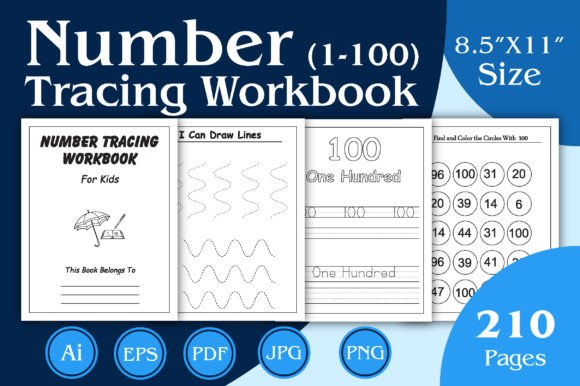
A Complete Number Tracing Workbook for KDP: Ready-to-Publish Pages for Kids’ Early Math Success
When you open the file for the first time, it hits you how much work has already been done. This isn’t just a handful of dotted lines. The Number Tracing Workbook for KDP delivers 210 fully designed pages, all sized at 8.5 x 11 inches with no bleed, meaning you can upload and publish almost immediately. Whether you’re an experienced KDP seller looking to refresh your catalog or a parent who wants to print out a few sheets at home, the real value becomes clear when you see how the content connects dots between play, practice, and genuine skill-building.
Why a 210-Page Number Tracing Book Solves a Real Problem for Publishers and Parents
Most activity books in the low-content space offer 50 to 100 pages, which feels substantial until a child finishes half the book in a weekend and parents want more. The 210-page interior included here covers number tracing from 0 to 100, which is rare. Instead of stopping at 10 or 20 like many workbooks, this one walks kids through every single digit, then into two-digit numbers, constantly reinforcing shape memory. For a KDP publisher, that’s a strong selling point—you can legitimately claim it’s a complete early math resource rather than a thin supplementary booklet.
Practically, the length matters in other ways too. Teachers who print pages for classroom centers can pull exactly the range they need without hunting across multiple files. Homeschool parents can stagger the content over an entire semester, doing a few numbers each week without ever running out of material. The workbook transitions smoothly from basic pencil control warm-ups at the start, to tracing individual numbers, to writing number words, then into a “find and color” section that breaks up the repetition. That progression isn't random; it mirrors how young learners actually move from gross motor readiness to fine motor precision and finally to recognition games that cement learning.
How the “Find and Color Right Number” Activity Turns Tracing into Play
Many tracing books treat every page identically: trace this, trace that, repeat. The Number Tracing Workbook for KDP includes a section where kids look at a set of scattered numbers and color only the correct one. It seems simple, but that shift from passive copying to active identification changes the entire dynamic. A child who was growing bored with line tracing suddenly feels like a detective. A first-grade teacher might use these pages as morning work while she takes attendance. A dad traveling with his daughter can print just the find-and-color sheets for the plane, knowing they require zero instruction.
That kind of variety also makes the book more marketable. Parents browsing Amazon often flip through the “Look Inside” feature, and a book that shows only rows of dotted numbers looks one-dimensional. But when they see a playful activity where kids search for the number 37 among other numbers—or color apples next to the numeral twelve—the product stands out. For sellers, this reduces return rates and builds better reviews because children actually enjoy using the pages, and parents feel they got something beyond a basic handwriting drill.
Customization Options for Different Niches or Markets
The download includes fully editable AI and EPS files, which means you aren’t locked into the exact layout as provided. Let’s say you run a small brand focused on Montessori-inspired learning materials. You could adjust the font, add your logo, or insert brief parent instructions at the bottom of each page before republishing. Another KDP seller might want to translate the number words into Spanish or French to tap into bilingual education markets. Because the source files are high-resolution and layered where applicable, even someone with basic Illustrator skills can make meaningful changes without rebuilding everything from scratch.
That level of control extends beyond digital publishing too. A freelance designer could use the files to fulfill custom orders for local preschools, printing and spiral-binding the workbook with the school’s name on the cover. Daycare owners might print the pencil control practice pages in bulk as part of their enrollment welcome kit. The 8.5 x 11-inch size with no bleed means any standard printer can handle it, so physical production costs stay predictable. You never have to worry about trimming or alignment issues that plague full-bleed interiors.
When and Where People Actually Use This Workbook
You’ll find the Number Tracing Workbook for KDP showing up in places you might not immediately expect. Kindergarten teachers print the 0–10 tracing pages during the first week of school to assess fine motor skills. ESL instructors working with older newcomers use the number word pages to connect English vocabulary with symbols they already know from their native language. Grandparents who babysit regularly keep a binder of printed sheets on hand because they can pull it out while cooking dinner, no Wi-Fi or tablet required. Even pediatric occupational therapists sometimes incorporate the pencil control exercises as part of a child’s sensory diet, especially the early pages that focus on loops, zigzags, and controlled strokes before numbers even appear.
The workbook also fits neatly into seasonal sales patterns. Many KDP publishers time their launches for late July to catch back-to-school buyers. But this interior has enough depth and games that it works equally well for summer bridging workbooks, Christmas stocking filler activity books, or even birthday party favor printable sets. You aren’t married to an August-only audience. Because the content is skill-based rather than holiday-themed, you can sell it year-round, bundling it with other early learning interiors or running a lower-priced promotion in January when parents renew their focus on educational routines.
What to Look for Before You Buy or Download a KDP Interior
Not all ready-made interiors handle the same way once uploaded to KDP. One of the first things you’ll notice here is the no-bleed setup. That eliminates the headache of calculating margins or accidentally chopping off tracing lines near the spine. You simply upload the PDF, verify the print preview, and order your proof. For anyone who’s ever struggled with uneven page alignment or had a book rejected due to bleed issues, that’s a legitimate time-saver.
Another detail worth paying attention to is the file variety: AI, EPS, PNG, JPG, and PDF. You don’t just get a flat collection of images in a single format. The editable vector files give you the freedom to repurpose the artwork for different products, like dry-erase placemats, flipbooks, or even cards. PNGs let you pull individual activity pages into other projects, such as a printable blog freebie or an educational app prototype. The inclusion of a high-resolution PDF means you can send the file straight to a local print shop for a personal physical copy without installing any editing software.
Still, you should consider your audience before uploading as-is. The number tracing extends to 100, which is excellent for kindergarten through second grade, but if you specifically target toddlers, you might separate out pages 0–20 into a standalone volume and keep the rest for a follow-up book. The beauty of having the editable files is you can make those splits later without buying additional assets. And because the interior doesn’t include any mention of a brand name or website on the activity pages, you’re free to publish under your own imprint, no attribution required.
Turning a Single Download Into Multiple Income Streams
A hands-on KDP creator rarely uses one interior only once. The pencil control practice section on its own can become a separate “Pre-Writing Skills for Preschoolers” workbook. The find-and-color pages could be extracted, enlarged slightly, and compiled into a “Number Search and Color” activity pad on Etsy. If you also sell on Teachers Pay Teachers, you have ready-made resources to list as individual worksheets or a full bundle, earning passive income from educators who don’t need the physical book. The PNG files let you create mockups that look professional, and the 8.5 x 11-inch ratio requires no cropping when you build product covers.
A small business owner who runs a tutoring center might use the editable AI file to add their logo in the corner and give the workbook as a free gift to new clients, keeping their brand in front of families every day at home. A blogger writing about early childhood development can feature a few example pages in a blog post, then offer the full PDF as a subscriber magnet to grow an email list. These secondary uses multiply the value far beyond a single KDP upload.
The Connection Between Pencil Control and Number Fluency That Most Books Miss
At first glance, the opening pencil control exercises look entirely separate from the math content. But anyone who has watched a four-year-old struggle to form a curved “2” or a symmetrical “8” understands the link. Those early swirls, straight lines, and loop de loops build the hand strength and spatial awareness that later translate into accurate number writing. The Number Tracing Workbook for KDP doesn’t assume children can jump straight into tracing numbers; it lays groundwork that makes the subsequent pages feel effortless rather than frustrating.
The word tracing component further bridges handwriting and reading. When a child traces the word “seven” next to the numeral 7, multiple brain areas activate simultaneously—visual recognition, phonemic awareness, and kinesthetic memory. That triad is what moves a concept from short-term exposure to long-term retention. Teachers often notice that kids who only learn to recognize numbers on a screen struggle to write them independently later. Giving them physical tracing pages that repeat the numeral and the written word closes that gap in a tactile, screen-free way.
For any publisher sitting on the fence about which interior to invest in next, the 210-page volume, editable sources, and careful balance of repetition and fun keep this book in the hands of kids longer than a typical tracing workbook. And a book that gets used fully is the kind of product that earns genuine recommendations, repeat buyers, and a steady flow of organic traffic—exactly what KDP sellers and content creators need.